

വീട്ടിലെ പരിചരണത്തിന് സാധാരണ കിടക്ക മതിയോ? എപ്പോൾ ICU Bed പരിഗണിക്കണം?
When a loved one comes home after a hospital stay, stroke, surgery or serious illness, families often ask a very practical question: “Can’t we use the normal bed and add a few pillows?” Sometimes, yes. If the person can move independently, change position with little help and sit comfortably for meals and daily activities, a familiar home bed may be perfectly suitable.
The question changes when mobility falls. If the person needs frequent repositioning, substantial help with personal care, repeated assistance getting in or out of bed, or has difficulty maintaining a comfortable position, pillows alone may become difficult to manage. An adjustable hospital-style or ICU bed can then be worth considering.
An ICU bed is not a treatment by itself. It is care equipment that can make positioning and some nursing or transfer tasks easier when it is properly selected and used. The aim is not to recreate a hospital room at home, but to make everyday care safer, more manageable and more comfortable.
When a normal bed may no longer be enough
Most of us change position during sleep without thinking about it. A person who is weak, paralysed, recovering from a major illness or dependent on others may not be able to do this effectively. Prolonged immobility is an important risk factor for pressure injury, and international guidance continues to recommend repositioning people at risk even when a pressure-redistributing mattress or specialist support surface is used.
A useful way to think about it: the bed helps with positioning, the mattress helps with pressure redistribution, and neither replaces good nursing care, skin observation or appropriate repositioning.
Pillows themselves are not unsafe. They are commonly used as positioning aids and may be entirely appropriate. The limitation appears when the person cannot hold the position independently. Several pillows may need constant rearranging, the person may slide down the bed, and carers may repeatedly lift or reposition them. An adjustable bed changes sections of the mattress platform itself, making some positions easier to reproduce consistently.
Four situations where an adjustable bed may help
1. Upright positioning is part of the care plan
People with swallowing difficulties or enteral tube feeding may receive specific positioning instructions from their clinical team. An adjustable backrest can make prescribed upper-body elevation easier to maintain than repeatedly rebuilding support with pillows. However, raising the head of the bed does not guarantee prevention of aspiration. Coughing, choking, a new wet or gurgling voice, or other swallowing difficulty needs clinical assessment rather than simply a different bed position.
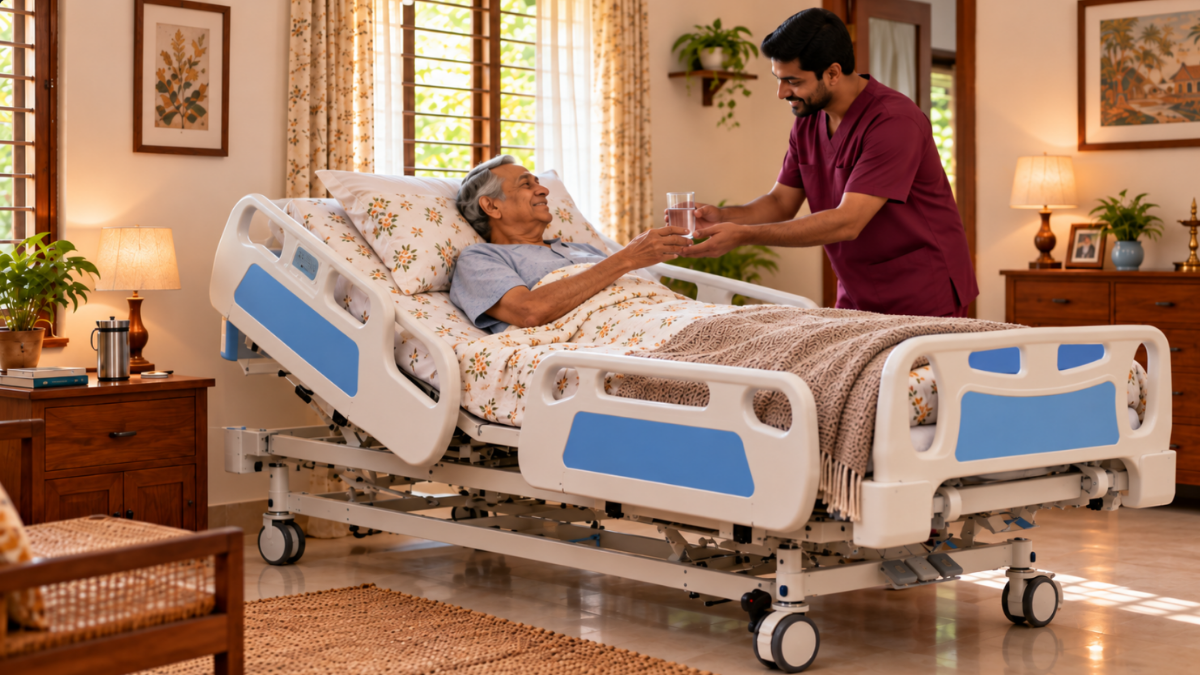
2. Pressure care is becoming important
An ICU bed does not automatically prevent bedsores. Pressure-injury prevention can involve mobility, skin condition, nutrition, moisture management, repositioning and the support surface. For a person spending long periods in bed, the mattress may be just as important as the bed frame. Depending on assessment, a pressure-redistributing foam or alternating-pressure system may be appropriate. Specialist equipment still does not remove the need for ongoing assessment and repositioning.
3. Bedside care involves repeated bending or reaching
Bathing, dressing, continence care, wound care, linen changes and repositioning can require repeated work at the bedside. A height-adjustable bed can allow the mattress platform to be raised to a more suitable working height for some tasks. This may reduce stooping and overreaching, but it does not guarantee that a caregiver will avoid injury. Correct moving-and-handling technique, adequate assistance and suitable transfer equipment may still be required.
4. Transfers have become difficult
Adjustable height may help prepare for selected assisted standing or wheelchair transfers. But the safest bed height depends on the individual and the activity. A useful rule is that caregiving height is not necessarily sleeping height. After care, the bed may need to be returned to a safer position, with wheels or brakes secured as directed by the manufacturer. People at high risk of falls, or with confusion or impaired mobility, need individualized assessment.
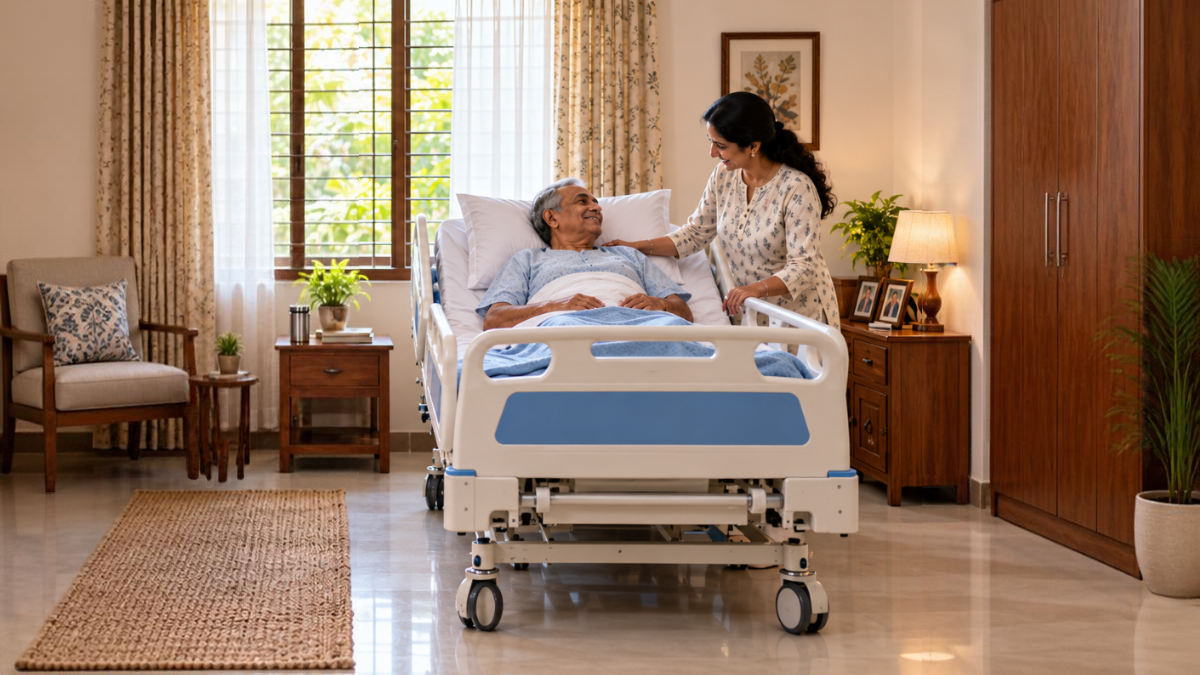
Normal bed vs adjustable ICU bed at home
| Care consideration | Normal home bed | Adjustable ICU / hospital-style bed |
|---|---|---|
| Independent person with good mobility | Often suitable | May not be necessary |
| Backrest / knee positioning | Usually relies on pillows or wedges | Adjustable platform on suitable models |
| Bed height | Usually fixed | Adjustable on height-adjustable models |
| Frequent bedside care | May involve more bending and reaching | Height adjustment can assist some tasks |
| Pressure-injury prevention | Needs suitable mattress, repositioning and care | Still needs suitable mattress, repositioning and care |
| Feeding / prescribed elevation | May be possible with suitable support | Can make prescribed elevation easier to reproduce |
| Transfers | Depends on bed height and mobility | Adjustable height may assist selected transfers |
| Bed rails | Add-on rails need compatibility assessment | Integrated rails still need safety assessment |
Bottom line: there is no single bed that is right for every patient.
Manual, 3-function or 5-function?
More functions do not automatically mean better care. A manual adjustable bed may be enough when position changes are infrequent and a caregiver is available to operate it. An electric bed can make repeated adjustments easier. More advanced beds may add height or tilt functions, but the meaning of “3-function” and “5-function” can vary by design and manufacturer. Families should compare the actual functions rather than the number in the product name.
Advanced positions should not be used simply because a bed can perform them. Where a position is intended for a medical purpose, it should follow appropriate clinical advice. For many families, the best bed is the simplest model that safely meets the person’s actual care requirements. You can compare the available ICU bed options before deciding whether rental or purchase is appropriate.
A safety point families often overlook: bed rails
Side rails can appear reassuring, but they are not automatically safer for every person. The U.S. Food and Drug Administration warns that inappropriate rail use can create risks including falls and entrapment between the rail, mattress and bed frame. Confused, restless or cognitively impaired people may need particular consideration. The mattress, rails and bed frame must also be compatible because unsuitable combinations can create dangerous gaps. Bed rails should therefore be selected as part of an overall safety assessment, not simply used as a barrier to keep someone in bed.
Do you need an ICU bed at home?
Consider asking for a professional assessment if the person:
- spends most of the day or night in bed or cannot reposition independently;
- repeatedly slides or becomes poorly positioned;
- requires frequent nursing or personal care in bed;
- needs substantial help with transfers;
- has an existing pressure injury or is considered at risk;
- receives tube feeding or has specific positioning instructions;
- has swallowing difficulty or cannot maintain an appropriate upright posture; or
- is being discharged after a major illness with significant ongoing home-care needs.
These situations do not automatically mean that an ICU bed is required. They mean the home-care setup deserves assessment. Sometimes the priority may instead be a better mattress, transfer aid, wheelchair or other mobility support, commode, physiotherapy, nursing support or a change in the care plan.
Renting or buying an ICU bed in Kerala
For short-term recovery, rehabilitation or uncertain future needs, renting can avoid purchasing equipment that may only be required temporarily. Purchase may make more sense when long-term use is expected. Instead of relying on a fixed rule such as “rent for X months, then buy,” compare expected duration, monthly rental cost, purchase price, maintenance or support, and the likelihood that the person’s needs may change. The decision should be clinical and financial, not financial alone.
Kerala also has a strong tradition of home-based care. The Kerala Health Department’s Universal Palliative Care Programme describes a statewide system involving primary palliative-care units, community nurses, local bodies, volunteers and home visits for bedridden patients. Families should remember that commercial providers are not the only possible source of support; depending on eligibility and local availability, public and community services may also help with home visits, nursing, rehabilitation or equipment.
Before the bed arrives: check the room
Make sure there is enough space around the bed for the patient, caregiver and any transfer or mobility equipment. For an electric bed, follow the manufacturer’s electrical requirements and avoid cables that can create trip hazards or be crushed by moving parts. Use wheels and brakes according to instructions. Most importantly, confirm that the bed frame, mattress, rails and accessories are compatible with one another.
Frequently Asked Questions
Is an ICU bed necessary for every bedridden patient?
No. Need depends on mobility, positioning, transfers, nursing requirements, pressure-injury risk and the overall care plan. Some people can be cared for appropriately on a normal bed with suitable supports.
Can pillows replace an ICU bed?
Sometimes. Pillows are legitimate positioning aids. The question is whether they provide stable, adequate support for that person. If frequent or repeatable adjustment is needed, an adjustable bed may be easier to manage.
Does an ICU bed prevent bedsores?
No. A bed alone cannot prevent pressure injuries. Appropriate support surfaces, repositioning, skin care, nutrition, moisture management and clinical assessment may all be relevant.
Is a 5-function electric bed always better than a 3-function bed?
No. Additional functions are useful only when they address a real care requirement. A simpler bed may provide everything a person needs.
Are ICU-bed side rails safe?
They can be useful for selected people, but they also carry risks including entrapment and falls. Patient factors and compatibility between the bed, mattress and rail should be assessed.
Should we rent or buy?
Renting may suit short-term or uncertain requirements; buying may suit anticipated long-term use. Compare duration, costs, support arrangements and the possibility that care needs may change.
The simplest way to decide
If your loved one is comfortable, can reposition adequately, and the current bed allows care to be provided safely, there may be no reason to replace it. But if each day involves rebuilding piles of pillows, struggling to maintain position, repeated bending for care, or increasingly difficult transfers, it may be time to reassess the setup.
The goal is not to recreate a hospital room at home. The goal is to use only the equipment that genuinely helps the person receive safer, more manageable and more comfortable care.
References
- National Pressure Injury Advisory Panel, European Pressure Ulcer Advisory Panel & Pan Pacific Pressure Injury Alliance – International Guideline: Support Surfaces (2026). Guidance on selecting pressure-redistributing support surfaces and matching them to individual needs. Source
- International Guideline – Repositioning (2026). Recommends repositioning people with or at risk of pressure injuries and notes that support surfaces do not completely replace repositioning. Source
- U.S. Food and Drug Administration – A Guide to Bed Safety: Bed Rails in Hospitals, Nursing Homes and Home Health Care. Guidance on benefits, risks, falls and patient entrapment associated with bed rails. Source
- U.S. Food and Drug Administration – Recommendations for Consumers and Caregivers about Adult Portable Bed Rails. Guidance on rail/mattress compatibility, entrapment and individual assessment. Source
- Kent Community Health NHS Foundation Trust – Positioning and Comfort When Enteral Feeding (updated 2026). Guidance concerning positioning during home enteral feeding. Source
- Health and Safety Executive – Health and Safety in Care Homes. Includes guidance on electric profiling beds, adjustable working height and moving-and-handling considerations. Source
- Kerala Department of Health and Family Welfare – Kerala Care: Universal Palliative Care Programme. Information on Kerala’s community and home-based palliative-care system. Source
Medical Disclaimer
This article provides general educational information about home-care equipment and is not a substitute for medical advice, diagnosis, nursing assessment, physiotherapy assessment or an individualized care plan.
The appropriate bed, mattress, positioning method, bed-rail configuration and transfer technique depend on the person’s medical condition, mobility, cognition, body size and other individual factors.
People with swallowing difficulties, tube feeding, breathing problems, pressure injuries, significant mobility limitations or complex medical needs should follow the advice of their treating healthcare professionals.
Seek urgent medical attention for choking, severe breathing difficulty, suspected aspiration, sudden deterioration, serious falls or other medical emergencies.
Not sure which bed fits your home-care needs?
Request an equipment assessment. We can explain practical differences between bed options and help you identify questions to discuss with the patient’s healthcare team.