
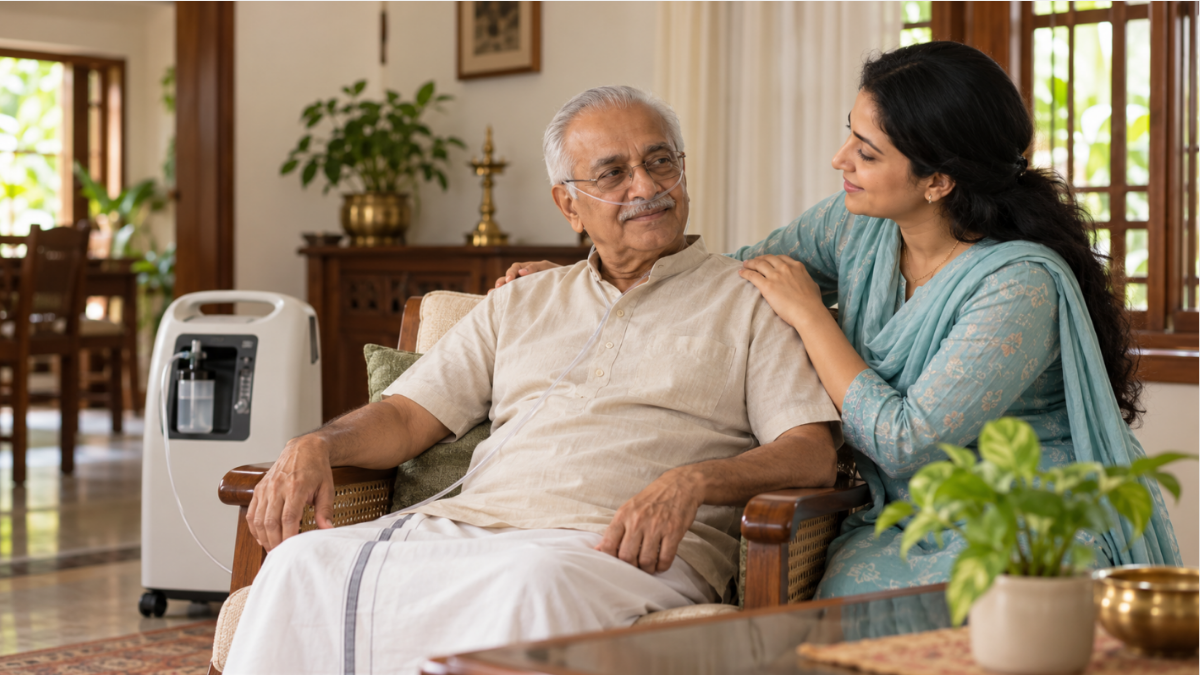
ഓക്സിജൻ കോൺസൻട്രേറ്റർ വീട്ടിൽ ഉപയോഗിക്കുമ്പോൾ ശ്രദ്ധിക്കേണ്ട കാര്യങ്ങൾ
HOME CARE INSIGHTS | RESPIRATORY CARE
Estimated read time: 10-12 minutes | For families, caregivers and home-care personnel in Kerala
Key principle: Oxygen, CPAP, BiPAP/NIV and other respiratory-support devices should be used according to a clinician’s prescription or care plan. Families should not change oxygen flow rates or ventilation pressures on their own.
Bringing respiratory equipment home is not only a clinical decision; it is also a practical household decision. Families need to know what the prescribed device is meant to achieve, how it will work during a power cut, what ongoing supplies or servicing it needs, and whether renting or buying makes more sense for the expected duration of use.
This guide looks at oxygen cylinders, 5 L/min and 10 L/min concentrators, CPAP and BiPAP/non-invasive ventilation (NIV) with one practical question in mind: what should a family understand before choosing, renting or buying the equipment? It also covers SpO2 monitoring, insurance/reimbursement questions, fire and power safety, and Kerala-specific support. It is educational guidance, not an individual prescription.
1. Start with the prescription – then make the equipment decision
Medical oxygen is a treatment for hypoxaemia, not a general remedy for breathlessness. Home oxygen should be prescribed for an identified clinical need, with a specified flow rate or target saturation range and a plan for review. The American Thoracic Society also emphasises patient and caregiver education on equipment use, troubleshooting and safety. [1]
The same rule applies to CPAP and BiPAP/NIV. CPAP is most commonly prescribed for obstructive sleep apnoea, while bilevel/NIV is used in selected conditions requiring different inspiratory and expiratory pressure support. Prescribed pressures, modes and oxygen flow rates should not be changed by the family unless the treating team has provided a specific plan. [3][4]
Practical principle: The most expensive or most powerful device is not automatically the right one. The useful question is whether the equipment reliably meets the prescription and can be supported safely in that particular home.
2. Four devices, four different jobs
| Equipment | What it is mainly used for | What to clarify before renting or buying |
|---|---|---|
| Oxygen cylinder | Stores compressed medical oxygen. Useful as a primary source in selected situations or as backup when electricity is unavailable. | Cylinder size and usable duration at the prescribed flow; regulator/flowmeter; trolley or secure stand; refill turnaround; backup plan. |
| Oxygen concentrator | Produces concentrated oxygen from room air while powered. Common home models provide up to about 5 or 10 L/min continuous flow. | Required flow; oxygen-concentration specification at that flow; alarms; power consumption; service history; filters; backup source during outages. |
| CPAP / APAP | Provides positive airway pressure, usually for obstructive sleep apnoea. Some models automatically vary pressure within a prescribed range. | Prescribed mode; mask fit; humidification if advised; data/app capability; consumable cost; trial/rental option; warranty and service. |
| BiPAP / NIV | Provides different inspiratory and expiratory pressures and can support ventilation in selected conditions. | Exact prescribed mode/settings; mask/interface; alarms; backup power; humidification; servicing; who supports the family if problems occur. |
WHO guidance treats oxygen equipment selection, procurement, utilisation and maintenance as connected decisions. In other words, choosing a device is not only about its headline specification; maintenance, reliable supply and the environment in which it will be used also matter. [5][6]
3. Oxygen cylinders: the machine is simple – the logistics are not
A cylinder works without electricity, which makes it particularly valuable as a backup for a patient who cannot safely be left without prescribed oxygen during a power failure. The trade-off is that the supply is finite. A family therefore needs to know not just the cylinder type, but approximately how long the available oxygen will last at the patient’s prescribed flow and how quickly a refill or replacement can be arranged.
For rental, the practical questions are often more important than ownership: Is the regulator included? Is the cylinder delivered secured in a stand or trolley? How are empty cylinders exchanged? Is there a second cylinder if the first is nearly empty? For purchase, ask about testing, regulator compatibility, refill access and future servicing. Do not assume that buying the cylinder itself solves the supply problem.
Before you rent or buy a cylinder: Ask the supplier to explain the cylinder capacity, expected usable time at the prescribed flow, refill process, regulator/flowmeter, safe storage and what happens if oxygen is needed outside normal delivery hours.
4. Oxygen concentrators: 5 L or 10 L is a capacity question, not a quality ranking
A 10 L/min concentrator is not automatically better than a 5 L/min model. The correct capacity depends on the prescribed flow and the performance of the specific device. Larger-capacity units may be heavier, consume more electricity and create more heat or noise. WHO specifications emphasise appropriate selection and maintenance rather than choosing the largest machine available. [5][6]
For a rented concentrator, ask whether the machine has an hour meter or service record, when preventive maintenance was last performed, whether oxygen concentration and alarms have been checked according to the supplier’s maintenance process, and what replacement support is available if the unit fails. For any concentrator, confirm the model-specific power requirement and plan the backup before the patient depends on it.
There is no universal “20-minute rest every eight hours” rule. Many medical concentrators are designed for continuous operation; filters, warm-up behaviour and service intervals should follow the exact model’s instructions. [5][6]
The useful buying question: Do not ask only “Is it 5 L or 10 L?” Ask whether the machine can reliably meet the prescribed flow, what alarms it has, how it is maintained, how much power it uses and what backup will be available during an outage.
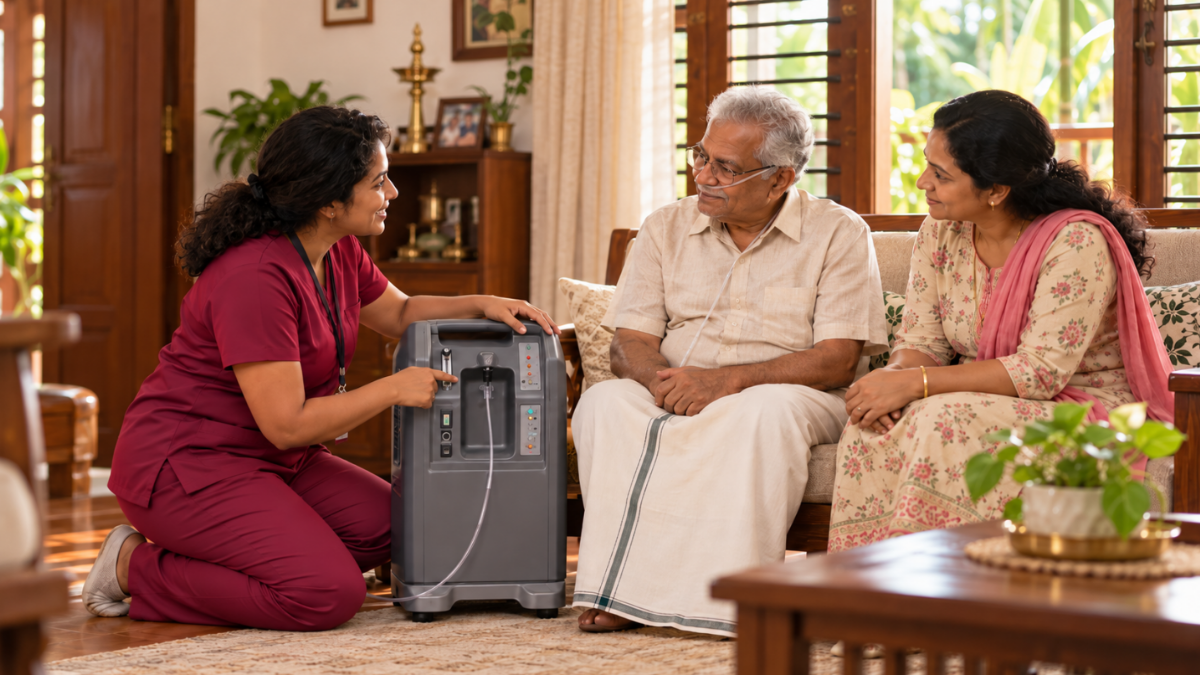
5. CPAP: comfort, data and long-term use matter as much as the machine price
CPAP is primarily a treatment for diagnosed obstructive sleep apnoea, not a general-purpose sleep tracker. But modern PAP devices can generate useful therapy data. Depending on the model, this may include usage hours, mask leak, treatment pressure and residual breathing-event information. These data can help clinicians assess adherence and troubleshoot therapy, although they do not replace a sleep study or clinical review. [15]
Another point that is easy to miss is that two auto-adjusting PAP devices with similar headline specifications can behave differently. APAP manufacturers use proprietary algorithms to detect breathing events, compensate for leaks and adjust pressure; bench studies and recent reviews show meaningful differences in device responses. [14][15] This does not make one brand universally “best”, but it explains why comfort and response can feel different from one machine to another.
For someone starting therapy, a properly supervised rental or trial period can sometimes help answer practical questions before purchase: Can the patient tolerate the mask? Is the machine comfortable to sleep with? Are leaks manageable? Which mask style works? The prescription and pressure settings still belong to the treating team.
Insurance bite: Before paying for CPAP, ask the insurer or TPA whether the policy has a Durable Medical Equipment, home-care or similar benefit. Some Indian policies specifically list CPAP and oxygen concentrators, while standard policies may exclude home-use durable equipment unless a rider or specific benefit applies. [13]
6. BiPAP/NIV: not simply a “more powerful CPAP”
BiPAP/NIV provides different pressure support during inhalation and exhalation and may be prescribed for selected patients who need ventilatory support. ATS guidance supports long-term NIV in selected people with chronic stable hypercapnic COPD, and NIV is also used in other conditions under specialist care. [4]
From a family’s point of view, the important difference is that the setup can be more clinically dependent than ordinary CPAP. Mask fit, prescribed pressures/modes, alarm behaviour, humidification, power backup and the ability to obtain prompt technical or clinical support all matter. A machine with more modes is not automatically safer if the required mode is not the one prescribed or if the family has not been trained to use the system.
Rental may be practical when the post-discharge requirement is still evolving or the expected duration is uncertain. Purchase may make sense for stable long-term prescribed use. There is no universal “rent for X months, then buy” rule; compare expected duration, rental cost, purchase cost, servicing, consumables and the likelihood that the care plan may change.
Before choosing NIV: Ask who will set up the prescribed mode, who will review the patient, what alarms the family must recognise, what happens during a power failure, how quickly a replacement device can be supplied and which masks/tubing are locally available.
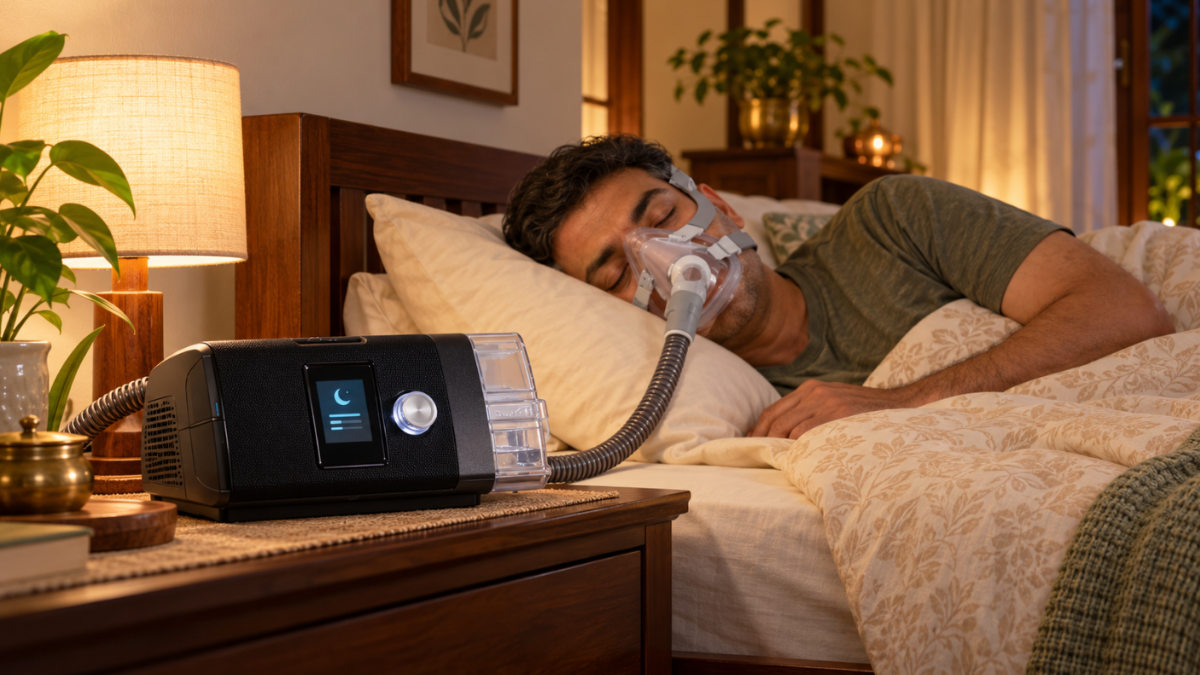
7. SpO2 monitoring: useful information, but not a diagnosis by itself
A pulse oximeter estimates peripheral oxygen saturation (SpO2). It is useful for spot checks or trending when the treating team has advised monitoring, but readings can be affected by movement, cold hands, poor circulation, nail polish and other factors. The FDA also notes accuracy concerns across different skin pigmentations. Symptoms and the patient’s overall condition matter alongside the number. [7]
Common clinical ranges such as 94%-98% for many acutely unwell adults and 88%-92% for people at risk of hypercapnic respiratory failure are not universal home targets. The correct home target should come from the treating clinician. If a reading is unexpectedly low, first check the patient, probe, tubing and equipment, then follow the patient-specific escalation plan rather than repeatedly increasing the oxygen flow. [2]
Seek urgent help for deterioration: Severe or rapidly worsening breathlessness, blue or grey lips/face, new confusion, collapse, inability to stay awake, chest pain or a persistently very low SpO2 outside the person’s prescribed range requires urgent assessment. In Kerala, 108 provides emergency ambulance service and 112 is the national integrated emergency number. [10][11]
8. Insurance and reimbursement: check before you make the payment
Home respiratory equipment is not treated identically by every insurer. Some policies exclude durable equipment used at home, while specific riders or reimbursement schemes may cover selected devices. New India Assurance currently offers a Durable Medical Devices Rider that lists an oxygen concentrator and CPAP among eligible devices, subject to its own base-policy, prescription, timing and limit conditions. [13]
Government reimbursement can also differ. The Ministry of Health and Family Welfare describes CGHS reimbursement for CPAP, BiPAP and oxygen concentrators subject to CGHS ceiling rates and guidelines. [16] This does not mean every private policy will pay, and it does not establish one universal compliance rule.
Before purchasing or signing a long rental, ask the insurer/TPA: Is the exact device covered? Purchase, rental, or both? Is pre-authorisation needed? Must the prescription be linked to hospitalisation or discharge? Are invoices/GST documents required? Are masks, tubing and other consumables excluded? Is there a time limit for submitting the claim? Get the answer in writing whenever possible.
9. Fire, power cuts and Kerala-specific planning
Oxygen itself does not burn, but it supports combustion and can make a fire burn much more intensely. Keep oxygen away from smoking, open flames and ignition sources, and keep oil and grease away from oxygen valves and fittings. NFPA advises keeping cylinders at least five feet from heat sources, open flames or electrical devices. [8] In a Kerala home, also think about LPG flames, nilavilakku/oil lamps, candles, incense and mosquito coils.
A concentrator stops when the power fails. Anyone who depends on continuous oxygen needs a written backup plan that may include a compatible inverter/battery arrangement and/or a backup cylinder, depending on clinical needs. KSEB has published a Life Support System electricity concession for eligible domestic consumers using an oxygen concentrator; families can ask their local Electrical Section about current eligibility. This is not a guarantee of uninterrupted supply or priority restoration. [12]
Kerala also has an extensive public and community palliative-care network through Kerala Care and local palliative services. Equipment availability varies, but families should ask the PHC/FHC, palliative-care team or local self-government institution what support is available before assuming everything must be purchased privately. [9]
10. Rent or buy? Use a seven-question test
There is no single financial rule that fits every respiratory device. Before deciding, answer these seven questions:
- How long is the equipment likely to be required, and is that duration medically predictable?
- Is the clinical requirement stable, or could the prescribed flow, mode or device change after review?
- What is included in the rental – delivery, setup, replacement, servicing, regulator, battery or accessories?
- What must be purchased separately – mask, tubing, humidifier chamber, filters or other consumables?
- What happens if the rented or purchased machine fails at night or during a weekend?
- Does insurance, CGHS or another reimbursement scheme apply, and what paperwork is required before payment?
- After adding servicing, electricity, refills and consumables, what is the real long-term cost – not just the advertised machine price?
For short-term recovery, uncertain post-discharge needs or a trial period, rental may reduce the risk of buying the wrong equipment too early. For stable long-term needs, purchase may eventually be more economical. The decision should follow the clinical requirement, not override it.
Frequently Asked Questions
Can I change the oxygen flow if the SpO2 falls?
Not unless the treating team has given a specific titration plan. Check the patient, probe, tubing and equipment first, then follow the prescribed escalation instructions.
Does a 10 L concentrator give “better oxygen” than a 5 L concentrator?
No. The number mainly describes maximum flow capacity. The correct machine is the one that meets the prescribed requirement reliably at the needed flow.
Can I rent CPAP before buying?
Rental or trial options may be available and can help assess mask tolerance and practical comfort. Therapy must still be clinically prescribed and set up appropriately.
Why can two CPAP/APAP machines feel different?
Auto-adjusting devices use different proprietary algorithms and comfort features. They may respond differently to breathing events or leaks, so model selection should consider the prescription, comfort, data capability and support rather than brand name alone. [14][15]
Is BiPAP simply a stronger CPAP?
No. BiPAP/NIV provides different inspiratory and expiratory pressures and is prescribed for different clinical situations. It is not an upgrade to choose without clinical indication.
Should I buy or rent a backup oxygen cylinder?
The important issue is whether the patient needs a backup source and whether it will be available when required. Ownership is secondary to capacity, refill access, safe storage and a clear contingency plan.
Will insurance pay for CPAP, BiPAP or a concentrator?
Sometimes, but coverage is policy-specific. Check the exact device list, rider/benefit, prescription requirements, purchase/rental rules, limits and claim deadlines before payment. [13][16]
The best home respiratory setup is the one the family can use confidently
Good respiratory care at home is not about owning the most expensive machine. It is about matching the equipment to a clear prescription, understanding what the device can and cannot do, checking the real costs before renting or buying, planning for service and power failures, and knowing when the patient needs medical reassessment rather than an equipment adjustment.
For ICU at Home, that means our role should be practical: explain the differences between available equipment, rental and purchase options, backup requirements and day-to-day setup. Clinical decisions – oxygen flow, target SpO2, CPAP/BiPAP mode and pressure – remain with the treating healthcare team.
References & Clinical Sources
1. American Thoracic Society. Home Oxygen Therapy for Adults with Chronic Lung Disease: An Official ATS Clinical Practice Guideline. Am J Respir Crit Care Med. 2020;202(10):e121-e141. ATS implementation tools: https://www.thoracic.org/statements/guideline-implementation-tools/home-oxygen-therapy-for-adults.php
2. British Thoracic Society. O'Driscoll BR, Howard LS, Earis J, Mak V. BTS guideline for oxygen use in adults in healthcare and emergency settings. Thorax. 2017;72(Suppl 1):ii1-ii90. https://thorax.bmj.com/content/72/Suppl_1/ii1
3. Global Initiative for Chronic Obstructive Lung Disease (GOLD). Global Strategy for Prevention, Diagnosis and Management of COPD: 2026 Report and Pocket Guide. https://goldcopd.org/2026-gold-report-and-pocket-guide/
4. American Thoracic Society. Macrea M, et al. Long-Term Noninvasive Ventilation in Chronic Stable Hypercapnic COPD: An Official ATS Clinical Practice Guideline. Am J Respir Crit Care Med. 2020;202(4):e74-e87. https://www.thoracic.org/statements/guideline-implementation-tools/long-term-niv-in-chronic-stable-hypercapnic-copd.php
5. World Health Organization. WHO Technical Specifications for Oxygen Concentrators. WHO Medical Device Technical Series; 2015. https://www.who.int/publications/i/item/9789241509886
6. World Health Organization & UNICEF. Technical Specifications and Guidance for Oxygen Therapy Devices. WHO Medical Device Technical Series; 2019. https://www.who.int/publications/i/item/9789241516914
7. U.S. Food and Drug Administration. Pulse Oximeters: limitations, home use and factors affecting accuracy. https://www.fda.gov/medical-devices/products-and-medical-procedures/pulse-oximeters
8. National Fire Protection Association (NFPA). Medical Oxygen Safety – home oxygen fire-safety guidance. https://www.nfpa.org/-/media/project/storefront/catalog/files/safety-tip-sheets/oxygensafetytips.pdf
9. Kerala Department of Health and Family Welfare. Kerala Care – Universal Palliative Care Programme. https://health.kerala.gov.in/
10. Kerala Department of Health and Family Welfare. Kerala Emergency Medical Service (108 Ambulance) – 24/7 medical emergency service. https://health.kerala.gov.in/
11. Government of India. Emergency Response Support System (ERSS) – national emergency number 112. https://112.gov.in/
12. Kerala State Electricity Board Limited. Guidelines / Board orders for free electricity supply to eligible patients surviving on Life Support System, including oxygen concentrator use. https://old.kseb.in/ (confirm current eligibility with the local Electrical Section).
16. Ministry of Health & Family Welfare, Government of India. CGHS facilities include reimbursement for CPAP, BiPAP and oxygen concentrators as per CGHS ceiling rates and guidelines. Ministry annual reports / CGHS guidance. https://www.mohfw.gov.in/
15. Auto-adjusting positive airway pressure: the fine line between engineering and medicine. Review, 2025. Discusses proprietary APAP algorithms, event detection, leak compensation, pressure adjustment and device data. https://pubmed.ncbi.nlm.nih.gov/40719998/
14. Farré R, et al. Comparative assessment of several automatic CPAP devices' responses: a bench test study. ERJ Open Res. 2016;2(1):00031-2015. Demonstrates manufacturer-specific APAP algorithms and different responses to the same simulated breathing patterns. https://pubmed.ncbi.nlm.nih.gov/27730142/
13. New India Assurance. Durable Medical Devices Rider. Current product information lists oxygen concentrator and CPAP among eligible devices, subject to rider terms, base-policy eligibility, prescription/timing conditions and limits. https://www.newindia.co.in/health-insurance/durable-medical-devices-rider
Medical Disclaimer
This article provides general educational information about home oxygen and respiratory-support equipment. It is not a substitute for medical advice, diagnosis, a respiratory assessment, a prescription or an individualized care plan. Oxygen flow rates, target SpO2 ranges, CPAP/BiPAP/NIV settings, masks/interfaces, humidification and backup arrangements must be selected for the individual patient by the appropriate treating healthcare professionals. Do not change prescribed oxygen flow or ventilator pressures on the basis of this article. Seek urgent medical attention for severe breathing difficulty, blue/grey lips or face, new confusion, collapse, inability to stay awake, chest pain, or other sudden deterioration. Insurance and reimbursement examples are illustrative and policy-specific; always verify current terms directly with the insurer, TPA or scheme before purchase or rental.
Need help choosing respiratory equipment for home?
Need help comparing an oxygen cylinder, 5L/10L concentrator, CPAP or BiPAP/NIV for rental or purchase? Request an equipment assessment. We can explain practical options, backup planning, consumables and costs; clinical settings and prescription changes remain with the treating healthcare team.