
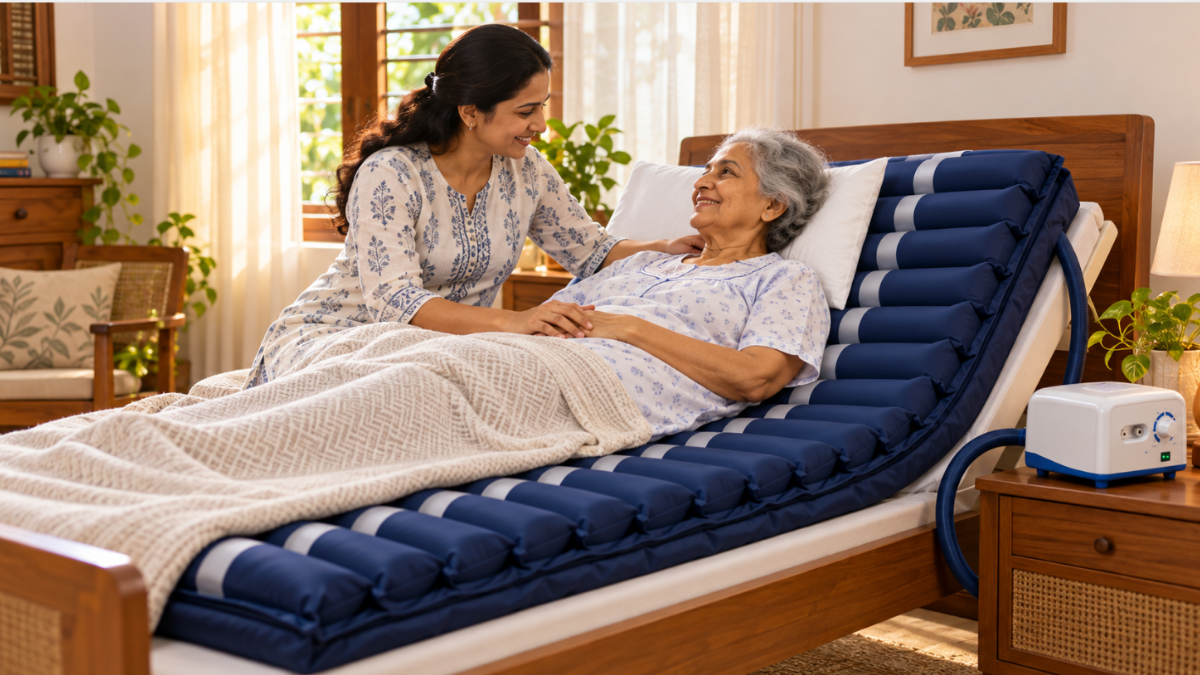
HOME CARE INSIGHTS | PRESSURE CARE
കിടപ്പുരോഗിയുടെ പരിചരണത്തിൽ മെത്ത എന്തുകൊണ്ട് പ്രധാനമാണ്? ശരിയായ പ്രഷർ കെയർ മെത്ത എങ്ങനെ തിരഞ്ഞെടുക്കാം?
Estimated read time: 9–11 minutes | For families, caregivers and home-care personnel in Kerala
KEY PRINCIPLE
A pressure-care mattress can reduce pressure-related risk, but it does not replace repositioning, skin checks, nutrition, moisture management or professional wound care. The right surface should match the patient’s mobility, skin condition, body size and overall care plan.
When a patient comes home after a stroke, major surgery, neurological illness or a prolonged hospital stay, families usually think first about medicines, feeding, oxygen, nursing and physiotherapy.
The mattress rarely receives the same attention. For someone who can turn, sit up and change position independently, that may not matter very much. But for a person who spends most of the day in bed and cannot reposition without assistance, the surface beneath the body becomes part of the care plan.
Pressure injuries—often called bedsores—develop when skin and deeper tissues are exposed to sustained pressure, or pressure together with shear. They occur particularly around bony areas such as the sacrum, hips and heels. Current international guidance therefore recommends choosing pressure-redistributing support surfaces according to the individual’s risk and needs. [1]
A BETTER QUESTION
Do not ask only, “Is an air mattress better than a normal mattress?” Ask, “What level of pressure redistribution does this particular patient need?”
Why an ordinary mattress can become inadequate
A normal household mattress is designed mainly for comfort and sleep. A pressure-care mattress has a different purpose: it is designed to spread load, reduce concentrated pressure and help manage factors such as friction, shear and the skin microclimate. [1]
Modern pressure-injury guidance describes two useful ideas: immersion—how effectively the body sinks into the support surface—and envelopment—how well the surface conforms around the body. Both can help distribute load more effectively rather than concentrating it over prominent areas. [1]
Mattress choice deserves particular attention when the person:
- cannot turn or reposition independently;
- spends most of the day or night in bed;
- has reduced sensation or significant frailty;
- repeatedly slides down the bed or is difficult to position;
- has had a previous pressure injury or already has skin damage;
- has a neurological condition or serious illness affecting mobility; or
- requires extensive nursing care in bed.
A clinical risk and skin assessment is preferable to choosing a mattress purely from a product description.
One number cannot tell you when a bedsore will develop
Older explanations sometimes reduce pressure-injury risk to a single pressure value or a fixed number of hours. Current guidance takes a more individual approach. Tissue damage depends on the magnitude and duration of loading together with factors such as anatomy, circulation, shear, moisture, illness and the person’s ability to move. [1][2]
That is useful for families because it means there is no universal formula that guarantees safety. The patient’s skin response, mobility and clinical condition should guide the prevention plan.
Two practical levels of pressure care
For home care, keeping the choice understandable is often more useful than presenting families with a long list of technologies. ICU at Home groups the common options into two practical categories:
- Standard Bubble Mattress — a lightweight alternating-pressure overlay for lower-intensity pressure care when clinically appropriate.
- Pressure Redistribution Mattress — a more substantial support surface for patients whose immobility, skin condition or overall risk justifies a higher level of pressure management.
The labels are practical categories rather than universal clinical grades. Exact cell design, pump functions, patient-weight limits and operating modes vary between products.
Standard Bubble Mattress: an accessible first step
A standard bubble air mattress is generally used as an overlay on an existing mattress. Many models contain interconnected air cells and a small electric pump that alternates pressure between areas of the surface. Exact cycle times, operating pressure and weight limits vary by model.
It may be practical for short-term recovery or lower-intensity pressure redistribution when the patient still has some mobility and the product is suitable for the individual’s weight and clinical risk.
GOOD TO KNOW
Affordable does not mean suitable for every patient. A bubble overlay should still be checked against the patient’s weight, mobility, skin condition and the manufacturer’s intended use.
One issue families should understand is bottoming out. If the person sinks far enough that the firm surface underneath effectively bears the load, the pressure-redistributing benefit may be reduced. International guidance identifies discomfort or bottoming out as reasons to reconsider the support surface, particularly when a pressure injury is already present. [3]

Pressure Redistribution Mattress: when the care requirement is higher
A more advanced pressure-redistribution mattress generally provides a deeper support surface with larger air cells or another specialised construction and a more capable pump or control system.
Depending on the model, features may include alternating and static modes, adjustable or automatic pressure control, low-pressure alarms, replaceable cells, CPR rapid-deflation functions and designs intended to maintain some support during a temporary power interruption.
These features vary by product and should be verified before purchase or rental rather than assumed from the words “advanced” or “medical grade.”
For people who already have a pressure injury, current guidance supports using an appropriate pressure-redistributing surface as part of the management plan. NICE recommends a high-specification foam mattress for adults with a pressure ulcer and considering a dynamic support surface if pressure cannot be redistributed adequately. [4] Evidence comparing different advanced surfaces is still uncertain, so one technology should not be presented as universally superior. [6]
IMPORTANT
A pressure-care mattress supports prevention and treatment. It does not treat a pressure injury by itself.
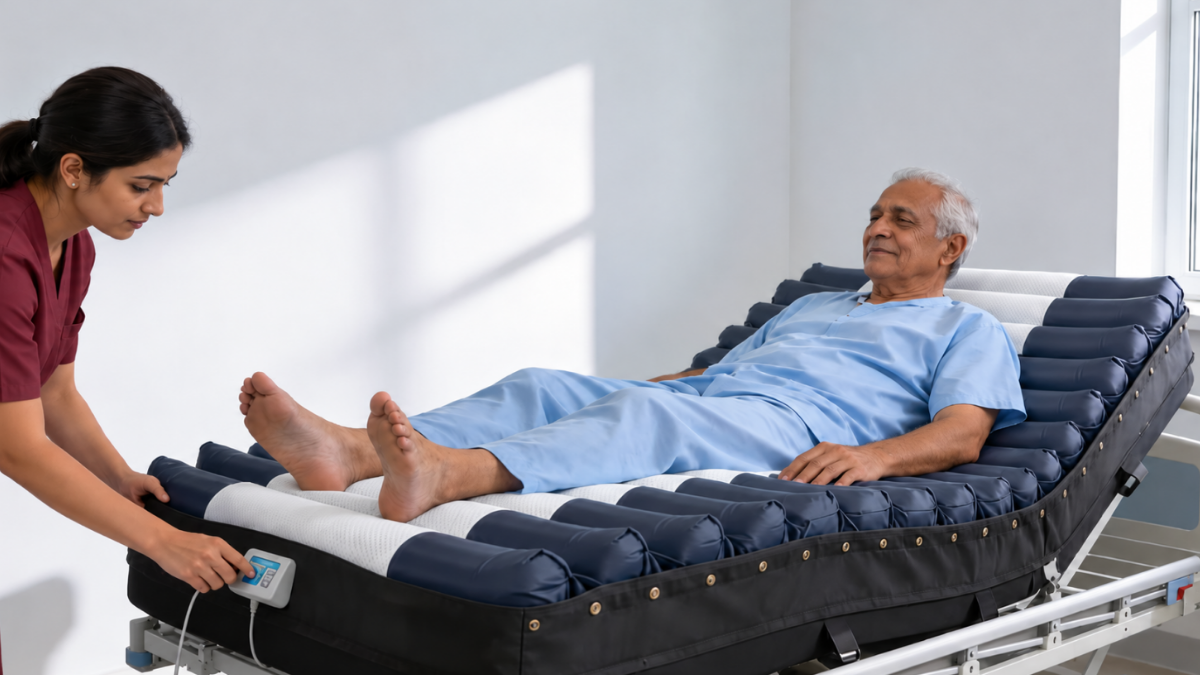
Bubble vs Pressure Redistribution: how should a family decide?
| Care consideration | Standard Bubble Mattress | Pressure Redistribution Mattress |
|---|---|---|
| Reduced mobility | May be appropriate | May be appropriate |
| Completely dependent for repositioning | Assessment recommended | Often deserves consideration |
| Existing pressure injury | Clinical assessment needed | Often considered as part of the care plan |
| Higher body weight | Check model capacity carefully | Higher-capacity options may be available |
| Pump / alarm sophistication | Usually basic | Often more advanced |
| Short-term recovery | Often practical | May be unnecessary in lower-risk cases |
| Long-term high-dependency care | May become inadequate | Often more suitable |
| Cost | Lower | Higher |
The price difference should never be the only difference you understand.
Five questions families rarely ask — but should
1. What is the maximum patient weight?
A support surface has to accommodate the person’s body size and weight within the manufacturer’s specifications. Current guidance recommends matching the surface to the individual’s size and body habitus. [1]
2. What happens if the electricity goes off?
For a powered system, ask what the mattress does during a power failure. Does it retain inflation for a period? Does its construction provide passive support? Do not assume every tubular mattress has the same backup design.
3. What happens if the pump fails at night?
For long-term rental, service response can matter as much as the mattress itself. Ask who replaces the pump, how quickly, whether replacement is included and what the family should do while waiting.
4. Are the cover and cells replaceable?
Long-term home-care equipment is exposed to sweat, urine, cleaning agents and repeated handling. Ask how the cover is cleaned, whether damaged cells can be replaced and how rental equipment is inspected between users.
5. What are you actually renting?
Clarify whether the quoted price includes the mattress, pump, connecting tubes, cover, delivery, installation, demonstration, routine servicing and replacement support.
BEFORE YOU RENT
A lower monthly price may not be the lower-cost option if servicing, pump replacement, delivery or essential accessories are charged separately.
A small detail that can make a big difference: the layers above the mattress
Families sometimes put several blankets, absorbent pads, plastic sheets and folded cloth layers between the patient and an expensive pressure-redistributing mattress. Too many layers can interfere with how the surface redistributes load.
The 2026 International Guideline advises ensuring that bed linen and other materials do not interfere with pressure redistribution, avoiding unnecessary layers and keeping sheets free of wrinkles. [1]
SIMPLE RULE
The mattress needs to be allowed to do its job. Use only the linen and protective layers that are necessary and compatible with the support surface.
An air mattress does not cancel repositioning
No pressure-care mattress means that a patient no longer needs repositioning. The 2026 International Guideline states that people with or at risk of pressure injury should still be repositioned regardless of the pressure-redistributing surface in use; no support surface can entirely replace repositioning. [2]
Repositioning frequency should be individualised according to mobility, skin and tissue tolerance, clinical condition, comfort, sleep, goals of care and the support surface being used. [2]
Do not forget the heels
Families naturally watch the back and buttocks because those areas are strongly associated with bedsores. The heels deserve equal attention. The International Guideline identifies the heel as one of the most common sites of pressure injury and notes that it can remain vulnerable even when a pressure-redistributing mattress is being used. [5]
For some patients, heel offloading or specific positioning may therefore be needed in addition to the mattress.
Look at the skin, not just the machine
During routine hygiene and repositioning, families and caregivers should watch for early changes rather than waiting for an open wound to appear. Useful warning signs include:
- persistent change in skin colour or discolouration;
- localized warmth or unusual coolness;
- swelling;
- tissue that feels unusually firm or soft;
- new tenderness or pain; and
- blisters or breaks in the skin.
In darker skin tones, redness may be difficult to recognise. Current guidance recommends combining visual inspection with touch and asking about localized pain or discomfort. [7]
ACT EARLY
If suspicious skin changes appear, do not simply increase the pump setting and wait. Arrange an appropriate clinical assessment.
Is the advanced mattress worth the extra money?
An advanced mattress may cost considerably more because its construction, pump, controls, alarms and replaceable components can be more sophisticated. But the useful comparison is not simply “cheaper mattress versus expensive mattress.”
The better question is: does the lower-cost surface adequately meet this patient’s needs?
Pressure injuries can become clinically serious. Established wounds may require specialised wound care and debridement, and complications such as infection or underlying osteomyelitis can require systemic treatment. NICE therefore recommends assessing and managing pressure ulcers as clinical wounds rather than relying on a support surface alone. [4]
This does not mean the most expensive mattress prevents every complication. It means under-specifying pressure care purely to save money can become a false economy when the patient is genuinely high risk.
Rent or buy?
For many Kerala families, this is more useful than asking which model is “best.”
Rental may make sense when:
- the person is recovering after hospitalisation;
- the expected duration is uncertain;
- the care requirement may change;
- a higher-level mattress is needed temporarily; or
- the family prefers servicing and replacement support rather than owning the equipment.
Purchase may make more sense when:
- long-term dependency is expected;
- the same level of pressure care is likely to be required for a prolonged period; and
- ownership is financially preferable after comparing the full rental cost and maintenance responsibilities.
Before deciding, compare expected duration, rental cost, purchase price, servicing, pump replacement, hygiene and maintenance, and the possibility that the patient’s condition will change. There is no medically valid rule such as “rent for three months, then buy.”
The questions to ask before the mattress arrives
- Is this an overlay or a full replacement mattress?
- What patient-weight range is it designed for?
- Is it reactive or alternating-pressure?
- What happens during a power failure?
- Does it have a low-pressure alarm?
- Are individual cells and the cover replaceable?
- Is servicing included?
- What happens if the pump fails?
- How should the cover be cleaned?
- Does the patient’s current pressure-injury risk require clinical assessment before choosing the surface?
WHAT A GOOD EQUIPMENT PROVIDER SHOULD DO
Explain the practical differences, confirm product specifications, show the family how to use the equipment and be clear about servicing and replacement support. Clinical decisions about wound treatment or risk level should remain with the treating healthcare team.
The simplest way to think about it
A pressure-care mattress should not be sold as a magical bedsore-prevention device. Nor should every bedridden patient automatically receive the most expensive mattress.
A better decision pathway is:
DECISION PATHWAY
Patient risk → mobility → skin condition → existing wounds → body size → caregiving needs → appropriate support surface
For someone with reasonable mobility and short-term needs, a Standard Bubble Mattress may provide an affordable level of pressure redistribution. For someone who is highly dependent, difficult to reposition, uncomfortable or bottoming out on the current surface, or who already has significant pressure damage, a more capable Pressure Redistribution Mattress may deserve consideration with the treating team.
The aim is not to buy more technology. It is to put the right surface underneath the right patient.
Frequently Asked Questions
Does an air mattress completely prevent bedsores?
No. Pressure redistribution can reduce risk, but repositioning, skin inspection, nutrition, moisture management and appropriate clinical care still matter.
Can an existing bedsore be treated simply by changing the mattress?
No. An appropriate support surface can be an important part of the treatment plan, but an existing pressure injury needs clinical assessment and wound management.
Is an advanced pressure redistribution mattress always better than a bubble mattress?
No. The correct surface depends on the patient’s risk and needs. More expensive equipment is not automatically necessary for a lower-risk patient.
Can we stop turning the patient once an alternating mattress is installed?
No. Current international guidance states that no support surface entirely replaces repositioning. [2]
When should we seek clinical advice?
New skin breakdown, persistent abnormal colour, dark or purple discolouration, unusual warmth or coolness, swelling, significant pain, discharge, foul smell or signs of infection deserve clinical assessment rather than simply changing mattress settings.
References & Clinical Sources
1. National Pressure Injury Advisory Panel, European Pressure Ulcer Advisory Panel & Pan Pacific Pressure Injury Alliance. Full Body Support Surfaces for Prevention of Pressure Injuries. In: Prevention and Treatment of Pressure Ulcers/Injuries: Clinical Practice Guideline, Fourth Edition. 2026 (updated 25 Aug 2026). Source
2. National Pressure Injury Advisory Panel, European Pressure Ulcer Advisory Panel & Pan Pacific Pressure Injury Alliance. Repositioning and Mobilization. In: Prevention and Treatment of Pressure Ulcers/Injuries: Clinical Practice Guideline, Fourth Edition. 2026. Source
3. National Pressure Injury Advisory Panel, European Pressure Ulcer Advisory Panel & Pan Pacific Pressure Injury Alliance. Full Body Support Surfaces for Treatment of Pressure Injuries. International Guideline, Fourth Edition. Source
4. National Institute for Health and Care Excellence (NICE). Pressure ulcers: prevention and management. Clinical guideline CG179. Recommendations for risk assessment, support surfaces, repositioning and management of established pressure ulcers. Source
5. National Pressure Injury Advisory Panel, European Pressure Ulcer Advisory Panel & Pan Pacific Pressure Injury Alliance. Preventing Heel Pressure Injuries. International Guideline, Fourth Edition. 2025. Source
6. Shi C, Dumville JC, Cullum N, et al. Beds, overlays and mattresses for preventing and treating pressure ulcers: overview of Cochrane Reviews and network meta-analysis. Cochrane Database Syst Rev. 2021;8:CD013761. Source
7. National Pressure Injury Advisory Panel, European Pressure Ulcer Advisory Panel & Pan Pacific Pressure Injury Alliance. Skin and Tissue Assessment. International Guideline, Fourth Edition. 2026. Source
Medical Disclaimer
This article provides general educational information about pressure-care mattresses and home patient care. It is not a substitute for medical advice, nursing assessment, wound-care assessment, physiotherapy advice or an individualized pressure-injury prevention or treatment plan.
Mattress selection should take account of the person’s mobility, pressure-injury risk, existing wounds, body size, cognition, circulation, skin condition and other clinical factors. Existing or suspected pressure injuries should be assessed by an appropriately qualified healthcare professional. Seek urgent medical attention for rapidly worsening infection, fever with clinical deterioration, severe pain, spreading redness, black tissue, significant discharge or other concerning deterioration.
Need help choosing a pressure-care mattress?
Not sure which pressure-care surface fits the patient’s needs? Request an equipment assessment. We can explain product functions, rental and purchase options; clinical wound-care decisions remain with the treating healthcare team.